


Mitsubishi Mirage and Mirage G4: Excellent Fuel Economy and CO2 Emissions
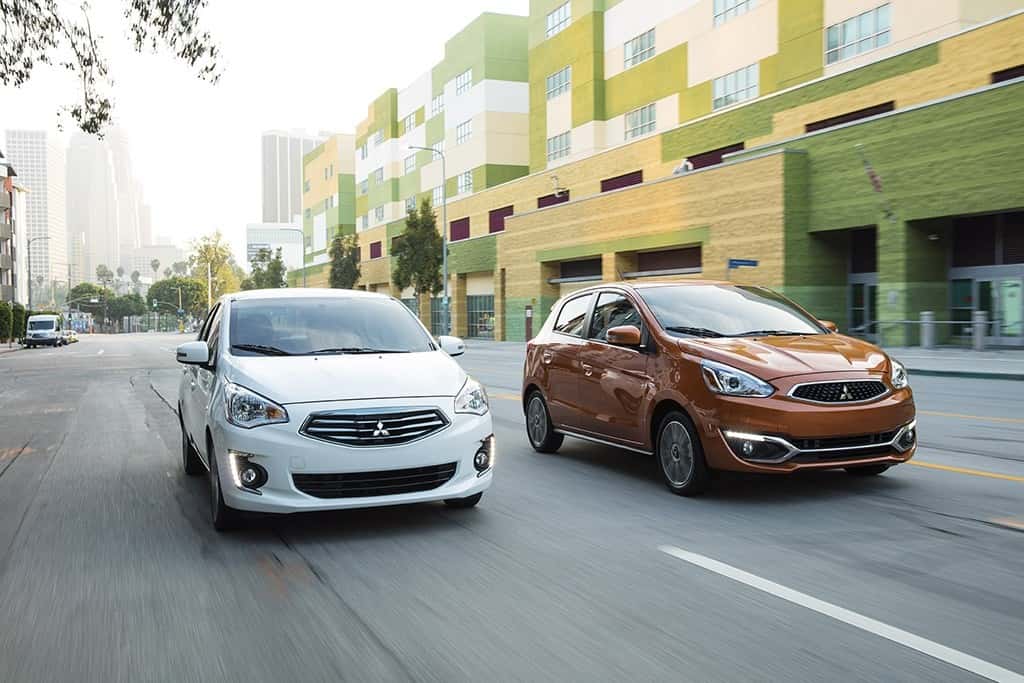
Fuel efficiency is an ever-increasing priority among car shoppers these days. Fuel-efficient cars like the Mitsubishi Mirage and Mirage G4 save drivers more money at the gas pump, but they also release fewer greenhouse gas (GHG) emissions than other vehicles in their class. Take a look at exactly how fuel efficient both Mitsubishi models are.
Engines and Fuel Economy
The 2017 Mitsubishi Mirage and Mirage G4 are both powered by a 1.2-liter MIVEC DOHC I3 engine. “MIVEC” is the term given to Mitsubishi’s own VVT, or variable valve timing design. It’s implemented into their engines to optimize vehicle performance and fuel economy. The power of both vehicles maxes out at 78 horsepower and 74 lb-ft of torque.
Fuel economy differs between the two vehicles, but stays static throughout the lineup. However, whether or not a trim has manual or automatic transmission, their fuel economy may change. The Mirage and Mirage G4’s automatic transmission is a continuously variable transmission (CVT), and unlike old automatic transmission systems, CVT is able to seamlessly switch between gears at various speeds without a loss of expended fuel.
The 2017 Mitsubishi Mirage has an EPA-rated fuel economy of 37/43 mpg city/highway when equipped with an automatic transmission and 33/41 mpg city/highway when equipped with a manual transmission.
The all-new 2017 Mitsubishi Mirage G4 has an EPA-rated fuel economy of 35/42 mpg city/highway with an automatic transmission and 33/40 mpg with a manual transmission.
Environmental Factors
So what does this all mean for the environment? Surprisingly, a lot.
Petroleum consumption and CO2 tailpipe and GHG emissions are the big players in the ways vehicles affect the environment. The 2017 Mitsubishi Mirage and Mirage G4 consume less petroleum and produce less CO2 tailpipe emissions than all other subcompact vehicles with a gasoline engine.
For example, the 2017 Fiat 500 uses an average of 11.4 barrels of petroleum per year, and the 2017 Chevy Spark uses an average of 10 barrels of petroleum per year. The Mitsubishi Mirage only consumes an average of 8.5 barrels of petroleum per year, and the Mitsubishi Mirage G4 consumes an averages of 8.9 barrels of petroleum per year. That’s excellent.
No vehicle with a gas engine releases zero CO2 tailpipe emissions, but the 2017 Mitsubishi Mirage comes close. The EPA has given the Mirage a 9 out of 10 (10 being the best) in terms of its amount of GHG emissions. The Mirage emits 226 grams of CO2 out of its tailpipes per mile, and the Mirage G4 emits 237 grams of CO2 per mile. On the other hand, the Chevy Spark emits 268 grams of C02 per mile and the 2017 Fiat 500 emits 300 grams of C02 per mile.
If all this has yet to persuade you. Let’s not forget the savings. According to FuelEconomy.gov, the the 2017 Mitsubishi Mirage has a total range of a total range of 359 miles and it saves the average driver about $2,250 in fuel costs*. The Mirage G4 has a total range of 340 miles and it can save the average driver about $2,000 in fuel costs*. That’s not pocket change, that’s a new TV, or family vacation, or a great deposit into a college fund. Everyone talks about leaving the world in better shape than we left it for future generations. Well these numbers speak for themselves, and with the Mitsubishi Mirage and Mirage G4, the world will be better off in the future.